Curriculum
Introduction
Curriculum Intention
Pupils will:
- be inspired by the teaching at our school
- be engaged and experience learning as enjoyable and fulfilling
- develop an enquiring mind, a love of learning and a thirst for knowledge
- develop the ability, attitude and organisational skills to work both independently and in collaboration with others
- master the key skills and achieve a level of competency sufficient to prepare them for the future challenges they will face
- experience success and enjoy opportunities to celebrate their achievements
At Nether Alderley Primary School, the curriculum is separated into three key areas:
- Early Years Foundation Stage [Reception]
- Key Stage 1 [Year 1 & 2]
- Key Stage 2 [Year 3, 4, 5 & 6]
As classes are organised in mixed-age groups, the school arranges its curriculum on a two-year rolling programme. The programme has been designed to promote cross-curricular links across areas of the National Curriculum, in order to enable pupils to apply knowledge, understanding and skills across a range of different subjects. This has proven to be a successful and enjoyable way of learning for our pupils.
If you wish to contact us for further information about the curriculum, please contact Mr Craven at .
Withdrawing You Child From Religious Education
If you wish your child NOT to take part in Religious Education lessons and activities, please talk to your child’s class teacher.
The Curriculum - A Summary
Curriculum Maps
Progression Maps for individual subjects
Music
Nether Alderley Primary School Music Development Plan 2024-25
British Values
In June 2014, the then Secretary of State for Education, Michael Gove, announced that schools would be required to promote British values from September of that year.
Department for Education guidance:
The Department for Education (DfE) has subsequently published guidance on promoting British values for both maintained and independent schools (see download below). The guidance suggests steps for schools to take to promote British values, including:
- Use teaching resources from a wide variety of sources to help pupils understand a range of faiths
- Ensure that all pupils within the school have a voice that is listened to, and demonstrate how democracy works by actively promoting democratic processes (such as a school council whose members are voted for by the pupils)
- Include material in the curriculum which considers the strengths, advantages and disadvantages of democracy, and how democracy and the law work in Britain, in contrast to other forms of government in other countries
What are British values?
According to guidance from the DFE, the fundamental British values are:
- Democracy
- The rule of law
- Individual liberty
- Mutual respect for and tolerance of those with different faiths and beliefs
Teaching British Values at Nether Alderley Primary School
We deliver British values education as part of our ongoing programme of study, making relevant links – where appropriate – to the topic areas studied in class. For example, in Y3/Y4, when learning about the Ancient Greek civilisation, pupils learn about the origins of democracy and how Great Britain is a democratic society. Then they apply this knowledge to our school context by considering the advantages and disadvantages of having a democratically-elected school council.
In addition to our curriculum programmes of study (identified here), British values are also explored through a range of assemblies and workshop opportunities, often delivered by external artists and educators.

Hall display of pupils’ work depicting the fight for racial equality during the civil rights movement
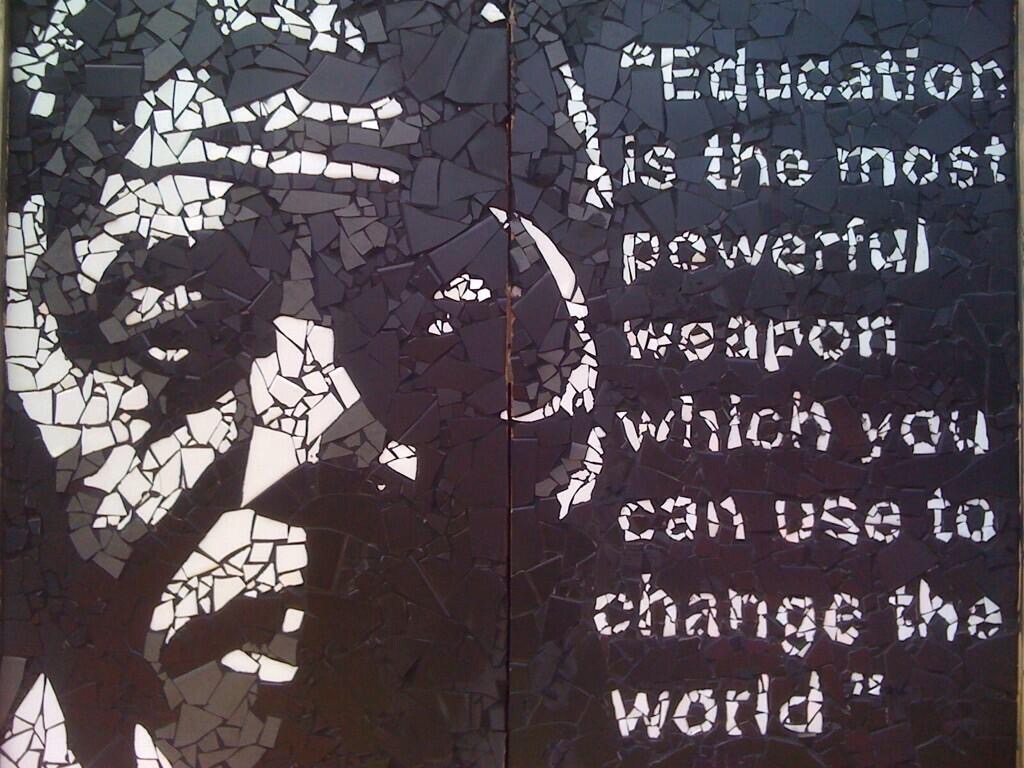
Children learn about inspirational figures such as Nelson Mandela. This enables them to recognise the importance of treating others, regardless of race, religion, disability or gender with equality and respect.
This beautiful mosiac is displayed on the outside of the school building.
Phonics & Reading Schemes
Lower Key stage 2At Nether Alderley we use the Little Wandle scheme for phonics and early reading.